
UCLA scientists build “cell villages” to study the developing brain
UCLA scientists are building a road map of how genetics shape the growth and survival of human brain cells. Using a cell village platform and a new statistical tool called Townlet that they developed, the team’s larger goal is to understand why some people are more vulnerable to developmental disorders and to toxic exposures.
Studying cell fitness, which is defined by a combination of how well cells grow and survive, provides key insights into how genetics and the environment relate to a range of medical conditions – shaping everything from organ size to the body’s ability to withstand disease. Differences in cell fitness, shaped by genetics and environment, can tip the scales toward developmental disorders, tissue degeneration and cancer.
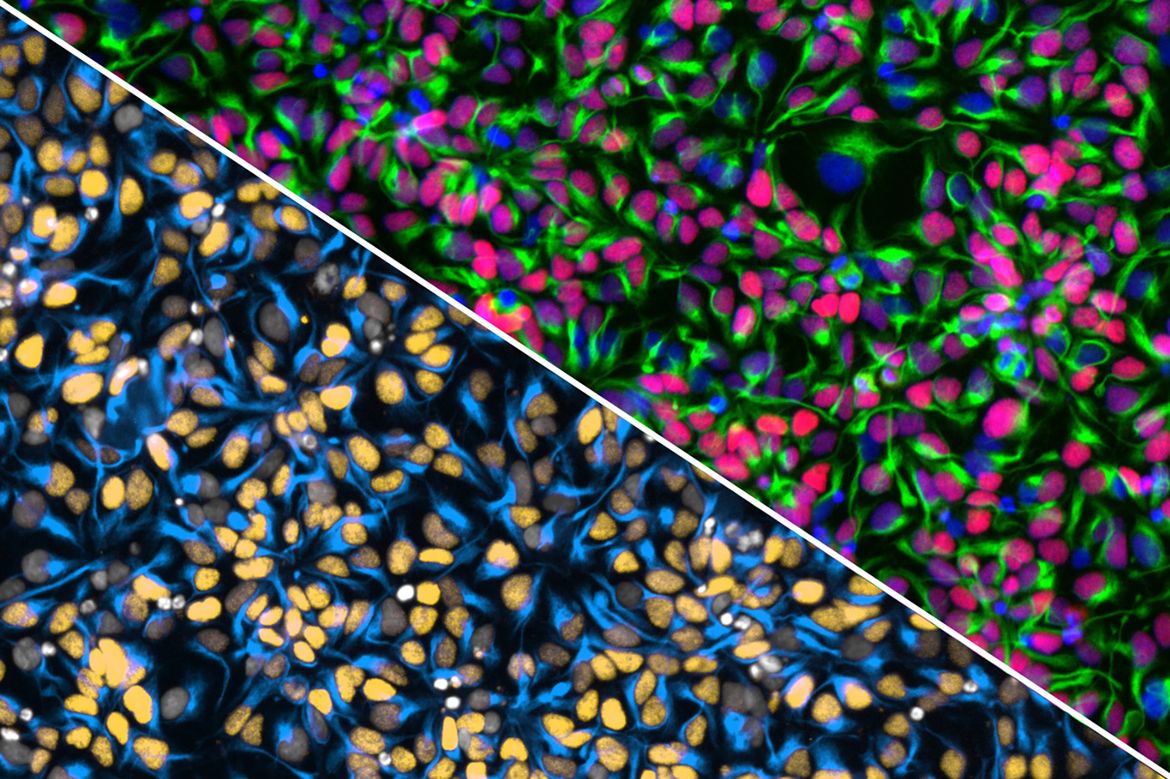 Image credit: Timothy Derebenskiy/Wells Lab.
“Everybody is curious about their own genetic predispositions and whether they should avoid certain exposures because they’re more sensitive than average,” said co-senior author Michael F. Wells, an assistant professor of human genetics at the David Geffen School of Medicine at UCLA and a member of the UCLA Broad Stem Cell Research Center
Gathering this data, however, is a costly and time-consuming undertaking. The researchers tackled this challenge with a cell village approach: pooling neural progenitor cells, which are the early cells that build the developing brain, into a single shared culture. These cells come from dozens of genetically distinct donors and grow under identical conditions.
By using cell villages, scientists have streamlined the process of collecting information about cell fitness. This strategy reduces reliance on animal studies and allows scientists’ access to a wider range of genetic diversity. Because every donor’s cells share the same dish, it also removes technical noise that can mask real biology, and the growth rates match what’s seen when donors are cultured separately. But researchers faced another obstacle: this method produces complex and tangled data that's difficult to decipher with standard statistical tools.
That’s where Townlet comes in, statistical tool that tracks each donor’s share of the village over time and helps tell apart a share that shrinks simply because all shares must add up to one from a share that shrinks because of genuine biology.
“When one slice grows, the others have to shrink to make room, because everything has to sum to one. But most standard statistical tools assume each slice doesn’t know about the others,” said Harold Pimentel, an assistant professor of computational medicine, computer science and human genetics at the Geffen School of Medicine.
The cell village approach and Townlet have already helped identify three scientific findings. In the largest study of its kind to date, the researchers tracked early brain cell overgrowth as a key driver of the larger heads seen in some people with autism. They also found two other DNA segments that were tied, separately, to how fast cells naturally grow and to how vulnerable they are to lead exposure.
Supported in part by the National Institutes of Health, this work is laying the foundation for more personalized medicine by creating an “atlas of human vulnerability,” as the research team describes. Townlet’s code has been made publicly available so researchers anywhere can use it to map genetically influenced fitness across many more cell types and exposures.